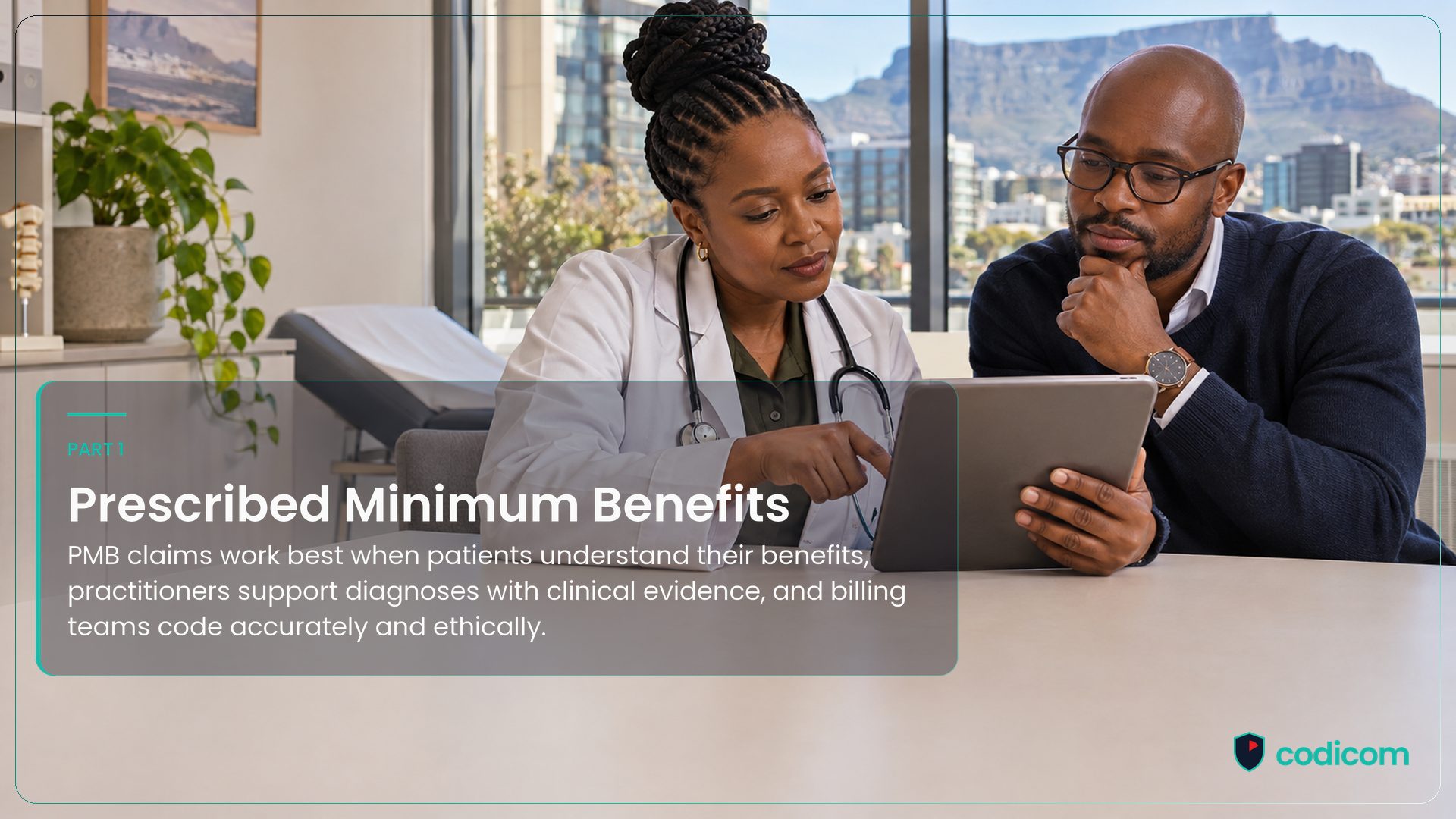
Prescribed minimum benefits: are we getting it right? | Part 1
PMB claims work best when patients understand their benefits, practitioners support diagnoses with clinical evidence, and billing teams code accurately and ethically.
Part 1 – Understanding our responsibilities
For some context, and to get the conversation started, I decided to do a simple Google search on what Prescribed Minimum Benefits (PMBs) are. I came across the following definition. Now, I’m not going to go into the requirements to have an episode of care funded as a PMB event. There are lots of literature out there which explains this process, but I want to focus on what we can do to streamline this process.
According to Google, Prescribed Minimum Benefits (PMBs) are mandatory healthcare benefits defined under South Africa's Medical Schemes Act 131 of 1998 and its Regulations. They require all registered South African medical schemes to cover the diagnosis, treatment and ongoing care of specific health conditions, regardless of a member's plan.
That sounds relatively straightforward in theory, doesn't it? Unfortunately, the reality is considerably more complicated.
Why do I say this? The answer is simple, and I'm going to explain it based on my experience dealing with all sides of the medical industry.
I believe there are four parties involved in making the PMB system work: the patient, the healthcare practitioner, the billing company and, of course, the medical schemes.
For this first article, I want to focus on the first three. I will dedicate Part 2 to the role of the medical schemes, because I believe that deserves an article of its own.
1. The patient
The average patient has very little understanding of what PMB cover actually means or, more importantly, how to access it.
Yes, most medical schemes explain PMBs in their benefit guides. But let's be honest: how many members actually take the time to read and understand those documents?
In all my years of working in medical billing, I cannot recall a medical scheme proactively contacting a patient to explain that their particular episode of care may qualify for PMB funding, what that means for their financial responsibility, or what steps they need to follow to access those benefits.
So, who ultimately ends up carrying the financial burden? More often than not, the patient.
When I worked at my wife's practice, doing patient-facing billing (a process where you have an office inside the practice where patients can come and discuss their accounts), I made a point of encouraging patients to take the time to read and understand their medical scheme's benefit guide.
Why? Because understanding your benefits is not just about knowing how much money is available in your savings account. It is about understanding the claims process, knowing what your scheme is required to fund and understanding where your financial responsibilities begin and end.
By doing this, patients are in a much better position to ask the right questions and challenge decisions when necessary.
If you deal directly with patients, whether you are a healthcare practitioner, billing consultant or receptionist, I want to encourage you to make patients aware of the importance of understanding their medical scheme's benefit guide.
There are potentially millions, if not billions, of rands being paid out of patients' own pockets every year because they are unaware of the benefits available to them and the rules governing their medical scheme membership.
We cannot expect patients to understand a system that we, as an industry, often struggle to navigate ourselves. But we can start by educating them.
2. The healthcare practitioner
I once had a doctor ask me to find a diagnosis code that would qualify for PMB funding because he wanted to claim at 300%.
I explained to him that every episode of care must be coded on its own merits and supported by the relevant clinical findings. These may include pathology results, blood tests, radiology reports and other clinical evidence that supports the diagnosis.
I also explained that, in my opinion, intentionally changing or manipulating a diagnosis simply to bring it within the parameters of PMB funding is fraudulent and completely unacceptable. A diagnosis must reflect the patient's actual clinical condition, not the financial benefit that may come with a particular code.
Fortunately, the doctor understood my reasoning and did not pursue the matter any further.
Unfortunately, not every healthcare practitioner approaches the matter with the same level of integrity. I see instances where practitioners are effectively "chasing the PMB bus", for lack of a better description. Instead of allowing the clinical findings to determine the diagnosis, they look for a diagnosis that will secure PMB funding.
This behaviour has consequences far beyond the individual account. When healthcare practitioners deliberately manipulate diagnoses to obtain PMB funding, they undermine the integrity of the entire system. It is precisely this kind of conduct that causes medical schemes to become increasingly suspicious of accounts submitted for PMB review, resulting in legitimate claims being questioned, delayed or rejected.
If we expect medical schemes to honour their PMB obligations, we must also expect healthcare practitioners to honour theirs.
PMB funding is a patient's entitlement where the clinical and regulatory requirements are met. It is not an opportunity to manipulate coding to achieve a better reimbursement rate.
3. The billing person or billing company
In one of my previous articles, I wrote about the importance of having a highly qualified person performing the medical billing function in your practice. I want to reiterate this because it is particularly relevant when dealing with PMB claims.
When a clinical coder codes an episode of care, they MUST do so in accordance with the South African Coding Standards, the relevant coding guidelines and all applicable rules and regulations.
Their responsibility is to accurately translate the clinical information provided by the healthcare practitioner into the appropriate diagnostic codes. Their job is not to manipulate the coding to achieve a more favourable financial outcome or to secure PMB funding.
I have heard of billing companies approaching healthcare practitioners and promising that they can get all their accounts paid at 300% by having them classified as PMB claims.
Let me be very clear: nobody can legitimately guarantee this outcome. PMB eligibility is determined by the patient's clinical condition, the applicable PMB regulations, the treatment provided and the relevant scheme rules. Any company promising guaranteed PMB funding, irrespective of the clinical circumstances, should raise serious concerns.
Do not fall for this. As the healthcare practitioner, you remain responsible for the clinical information and diagnoses supporting your claims. Outsourcing your billing function does not remove that responsibility. A billing company cannot simply take responsibility for an incorrectly coded or deliberately manipulated claim on your behalf.
I have said this before, and I will continue to advocate for the establishment of a governing body for medical billing companies. We need proper industry standards, recognised qualifications, accountability and oversight so that we can eliminate the few operators who bring the entire industry into disrepute.
My advice to healthcare practitioners is simple: stay clear of companies making unrealistic promises about guaranteed PMB funding.
If every episode of care is coded on its own merits, supported by the appropriate clinical documentation, pathology reports, laboratory results and radiology findings, then we will be submitting legitimate PMB claims that can be properly assessed by medical schemes.
Accurate coding should be about getting the clinical picture right, not getting the account paid at a higher rate.
So, where does this leave us?
We have three parties who all have a responsibility to make the PMB system work:
Patients need to understand their medical scheme benefits and know what they are entitled to.
Healthcare practitioners must ensure that their diagnoses are clinically justified and properly documented.
Billing companies must ensure that claims are coded accurately, ethically and by appropriately qualified individuals.
But there is another very important party in this equation.
What responsibility do the medical schemes have? Are they doing enough to educate their members, assess legitimate PMB claims fairly and ensure that patients receive the benefits they are legally entitled to?
And are medical schemes themselves contributing to the problems we are experiencing with PMB funding?
That is where I want to take this conversation next.
In Part 2, I will look at the role of the medical schemes, share some practical experiences from Codicom and discuss what I believe needs to change if we are going to get PMBs working the way they were intended to.
This is a conversation that needs to happen, and I would like to hear your views.

Practice Matters
Practical perspectives for building a stronger, more sustainable healthcare practice — from Codicom.
Subscribe on LinkedIn