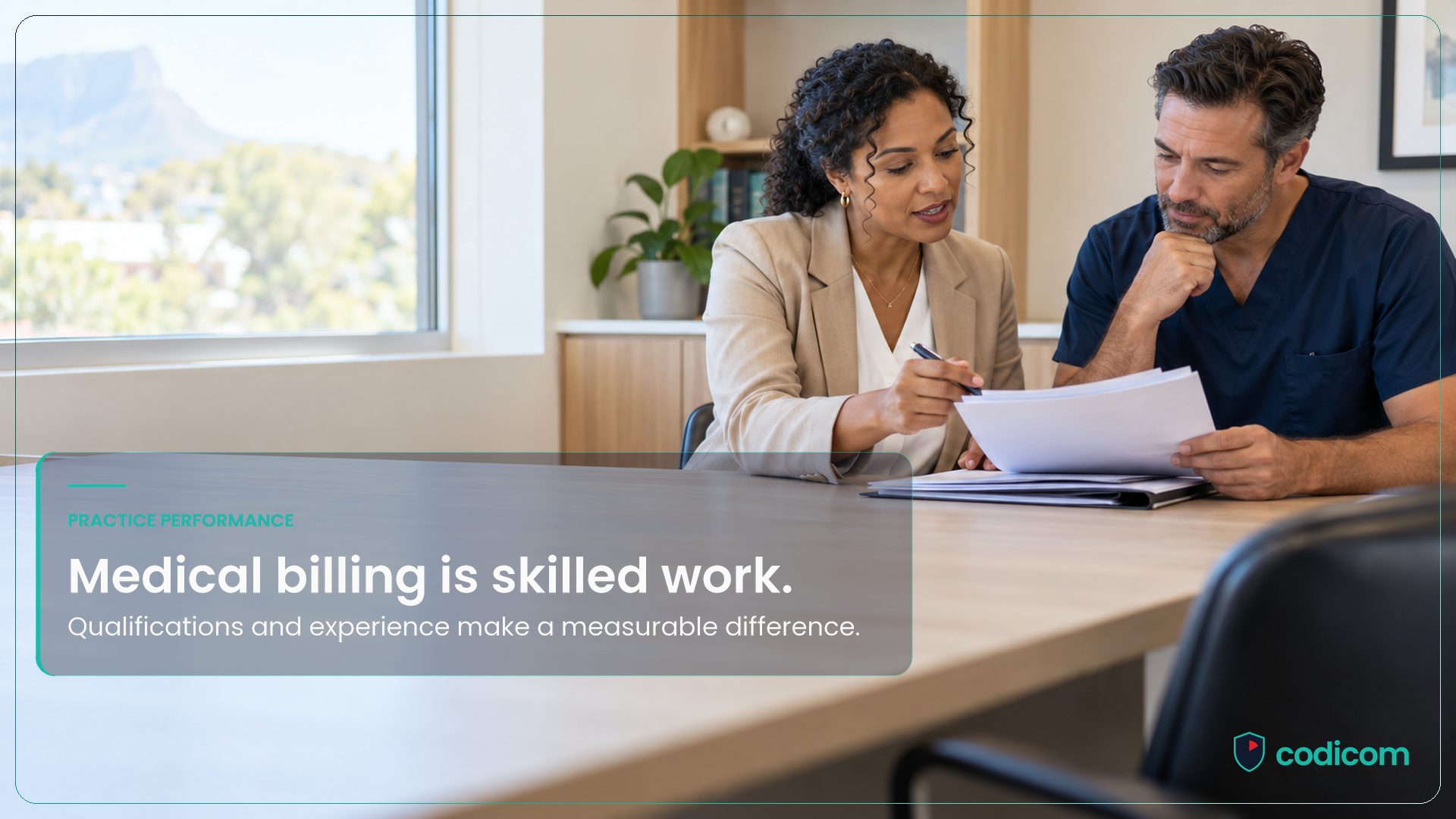
Medical Billing Is Skilled Work
Medical billing is skilled work, and the qualifications and experience of the person handling it can make a measurable difference to a practice’s performance.
I’ve seen many practices struggle financially, even though they are busy. When I’m called in to conduct a practice evaluation, I always engage with the billing company, and it is concerning to discover how unqualified some of them are. Don’t get me wrong: there are reputable, well-educated billing companies out there that serve their clients with integrity, but there are some who seem to be in it for a quick buck.
If you look at it from a business perspective, would you put the future of your multi-million-rand specialist practice in the hands of an unqualified person? The answer should be a resounding no, yet our healthcare practitioners do exactly that.
The best excuse I’ve ever heard when I asked a doctor why he was using a specific billing company was that he liked the person. I like the car guard at my office. I even buy him Christmas gifts every year, in addition to all the other things we do for him. But would I trust him with my business? That would be an emphatic no. Why, then, do you do this with your practice?
Healthcare practitioners often think a billing company should be an entity they never hear from, someone who works remotely and never bothers them. However, a billing company is an integral part of the treatment process.
For example, the HPCSA’s ethical guidance on informed consent makes it clear that patients should be informed of the costs associated with their treatment as part of the consent process. The HPCSA’s Booklet 19: Guidelines on Matters Relating to Ethical Billing Practices also addresses the responsibility to inform patients of fees before fee-generating activities commence, wherever possible.
This is where a qualified billing company plays a vital role. Patients need to understand the costs of their proposed treatment, including potential out-of-pocket expenses and medical scheme shortfalls, before treatment begins. Who calculates these costs? Not the healthcare practitioner, but the billing company, by means of quotations.
This is where the billing company’s expertise needs to come to the fore. The billing company needs to understand how specific medical schemes reimburse healthcare practitioners, what the practice’s policy is regarding the percentage of scheme rates the healthcare practitioner wants to charge for treatment, and how to communicate these costs clearly to the patient.
Our healthcare practitioners do not receive formal training in clinical coding and most of the business aspect of their practice. It’s not their fault; it’s simply the way things are. Your billing company, however, should be well qualified in this field. That is the kind of expertise you pay them for.
In an ideal world, the healthcare practitioner should tell the billing company what was wrong with the patient and what interventions were performed to restore the patient’s health. It is the billing company’s responsibility to translate these diagnoses and treatments into codes, which are then submitted to the medical schemes for payment. That is the billing company’s area of expertise, not the healthcare practitioners.
I have always called for the regulation of the medical billing industry because of what my team and I at Codicom have witnessed in the practices we have worked with. Medical billing is skilled work that requires qualified professionals with years of experience. It should not be treated as an easy way for just anyone to make money from our healthcare practitioners. Consider Australia, for example. The Health Information Management Association of Australia (HIMAA) requires Full Members to hold a degree in Health Information Management accredited by the Association or by another entity recognised through a Memorandum of Understanding.
In South Africa, we refer to this field of work as medical billing. Yet, in Australia, the profession of health information management is supported by formal academic qualifications and professional standards. Why should we accept a different standard here in South Africa? Are the Aussies really better than us, or have they simply recognised the importance of professional qualifications and standards in healthcare administration?
When a billing company offers you a discounted fee or any other benefit beyond excellent billing services to secure your business, it may not be the right fit for your practice. Why would a company need to lure you in with promises of special benefits if it is genuinely qualified to perform the work? Perhaps it is hiding something, such as a lack of qualifications.
When considering a billing company, ask about the qualifications of the person who will be handling your practice’s billing. This is an important step towards ensuring that you have the right person for the job.
Lastly, I want to emphasise that a billing company should never be a liability but always an asset. Think of a good tax consultant who can advise you on which expenses you can claim and which you cannot. A reputable billing company is no different. It should have sufficient knowledge and expertise to advise healthcare practitioners on which codes to use, and which services are already included in the main procedure, for instance.
A good billing company should make a measurable difference to your turnover through its recommendations, based on the rules, guidelines and requirements of the relevant governing bodies.
At Codicom’s billing division, we set very high standards. You cannot be part of our team without a formal qualification. Every single person in this division is highly qualified and brings years of industry experience and expertise to the table, enabling them to advise our healthcare practitioners.
When did you last review the work your billing team does, and the value it brings to your practice? Learn more


Practice Matters
Practical perspectives for building a stronger, more sustainable healthcare practice — from Codicom.
Subscribe on LinkedIn